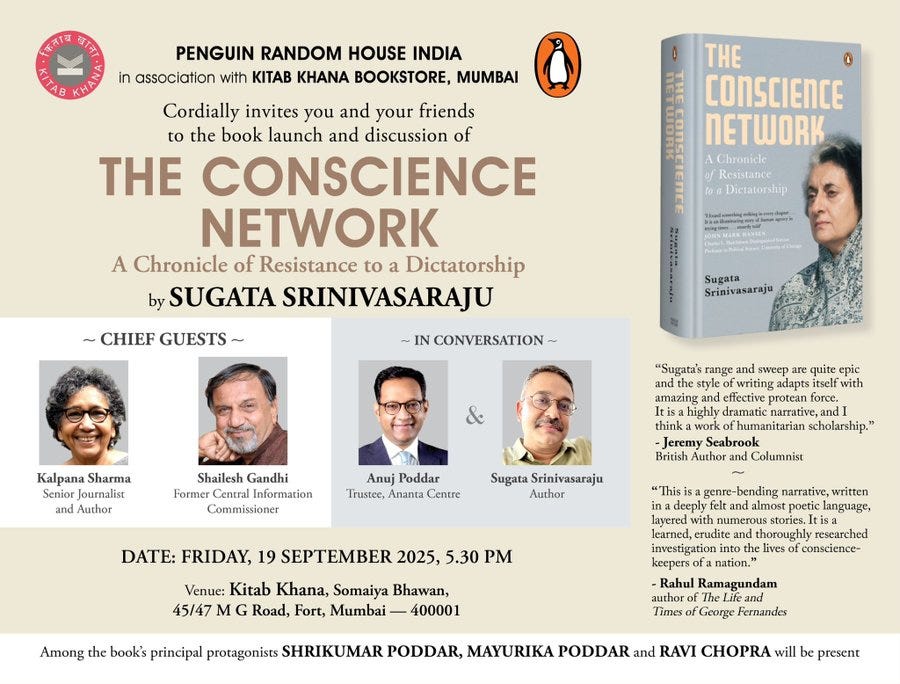
The Conscience Network
It is a year since my book The Conscience Network, a parallel history of resistance to Indira Gandhi's Emergency rule (June 1975-January 1977), was published by Penguin Random House

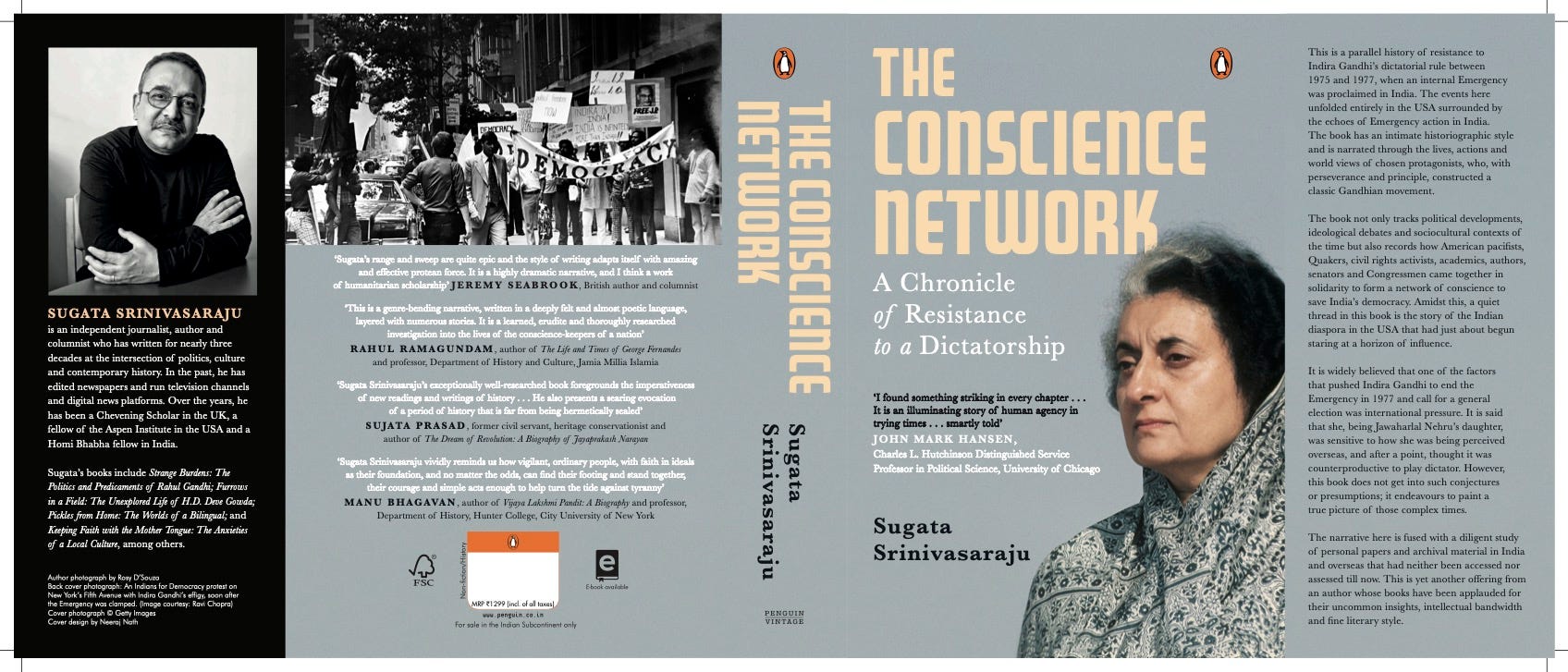
THE CONSCIENCE NETWORK: A CHRONICLE OF RESISTANCE
TO A DICTATORSHIP
Author: Sugata Srinivasaraju
Pages: 592
Publisher: Penguin Random House, Viking imprint
Link to buy on Amazon: https://amzn.in/d/06S7YUC5
THE PUBLISHER’S BLURB:
This is a parallel history of resistance to Indira Gandhi’s dictatorial rule between 1975 and 1977, when an internal emergency was proclaimed in India. The events here unfolded entirely in the USA surrounded by the echoes of emergency action in India. The book has an intimate historiographic style and is narrated through the lives, actions and worldviews of chosen protagonists, who with perseverance and principle constructed a classic Gandhian movement.
The book not only tracks political developments, ideological debates and socio-cultural contexts of the time, but also records how American pacifists, Quakers, civil rights activists, academics, authors, senators and Congressmen came together in solidarity, to form a network of conscience to save India’s democracy. Amidst this, a quiet thread in the book is the story of the Indian diaspora in the United States that had just about begun staring at a horizon of influence.
It is widely believed that one of the factors that pushed Indira Gandhi to end the emergency in 1977, and call for a general election was international pressure. Being Jawaharlal Nehru’s daughter it is said that she was sensitive to how she was being perceived overseas, and after a point, thought it was counterproductive to play dictator. However, this book does not get into such conjectures or presumptions, but endeavours to paint a true and complex picture of the time.
The narrative here is fused with a diligent study of personal papers and archival material in India and overseas that had neither been accessed or assessed till now. This is yet another offering from an author whose books have been applauded for their uncommon insights, intellectual bandwidth and a fine literary style.
**
ENDORSEMENTS:
Sugata Srinivasaraju’s new book, The Conscience Network, is a fascinating look at Indians for Democracy, the shoestring organization of Indian students, expatriates, and exiles in the United States who campaigned to overturn Indira Gandhi’s Emergency and restore democratic rule in India. I found something striking in every chapter. The leaders’ insistence on unity of action, not unity of ideology. The use of networks, communications, and public protest to raise awareness in the Indian community and among the American people, the press, and the solons in Washington. The political skills the founders brought from India and their shared connections to J. P. Narayan. The lessons they took from the recent movements in the U.S. for civil rights, women’s rights, and an end to the Vietnam War – and from America’s own democratic crisis, the Watergate scandal and the resignation of President Nixon. The shared admiration for the principles of Mahatma Gandhi that gave Indians and Americans common cause. It is an illuminating story of human agency in trying times, smartly told – with a sobering resonance in our own moment, on both sides of the globe.
--- John Mark Hansen, Charles L. Hutchinson Distinguished Service Professor in Political Science and the College, University of Chicago
**
Sugata Srinivasaraju has a new and original approach in this book; very different from his earlier works. His resume of the mood in India and the USA in the 1970s is extraordinarily incisive and evocative, and it all falls in place quite wonderfully. Sugata’s range and sweep are quite epic and the style of writing adapts itself with amazing and effective protean force. It is a highly dramatic narrative, and I think a work of humanitarian scholarship.
--- Jeremy Seabrook, British author and columnist
**
The Conscience Network provides a comprehensive account of events that unfolded abroad — mainly in the USA, but also in Europe — during the nineteen months of 1975-77, when India was under Indira Gandhi’s National Emergency. During those tumultuous and authoritarian times, characterized by a dictatorship with dynastic and despotic ambitions and launched by a desperation at the urgent loss of power, a group of young Indians—mainly, four, but many more—gathered together in American cities to propel an inclusive resistance by mobilising a diverse diaspora. They organised long marches, published newsletters, released political advertisements, launched telegram-campaigns, and conducted speaking tours. They built organisations, raised funds, lobbied American influencers, and gathered signatures to demand the release of political prisoners in India. A collective of former and current Indian students in America, taking inspiration from the social and political ferment in that country, addressed the conundrum in India, often at significant personal risks. This is the story of their Indian dream, resilience, and triumph. Fifty years after their initial gathering in the USA, these vibrant individuals are again brought together in this book to tell what they did, and share their experiences and achievements.
After engaging with a former Prime Minister and a current prime minister in contention, Sugata Srinivasaraju, the exceptional journalist-writer, presents this monumental chronicle of an era marked by idealism—an era that believed in pursuing larger causes for the country and its people, even at the cost of personal careers. This is a genre-bending narrative, written in a deeply felt and almost poetic language, layered with numerous stories. It is a learned, erudite and thoroughly researched investigation into the lives of conscience-keepers of a nation.
--- Rahul Ramagundam, author of The Life and Times of George Fernandes and Professor, Department of History and Culture, Jamia Millia Islamia
**
In the last fifty years a lot has been written about the subversion of democracy during the Emergency. Sugata Srinivasaraju’s exceptionally well researched book foregrounds the imperativeness of new readings and writings of history. He uses archival material quarried from private and public collections to weave a powerful narrative on the resistance built against Indira Gandhi’s monumental misstep overseas. He also presents a searing evocation of a period of history that is far from being hermetically sealed. As Faulkner said, the past is never dead, it is not even past.
--- Sujata Prasad, former civil servant, heritage conservationist and author of Dreams of a Revolution: A Biography of Jayaprakash Narayan
**
The Emergency is a chapter of India’s history that warrants perpetual revisitation for its many lessons on the fragility of democracy, the dangers of unchecked power, and the capriciousness with which many can easily be made to suffer. Drawing on new research, this book tells the story from the perspective of a small band of Indians living abroad. Sugata Srinivasaraju vividly reminds us how vigilant, ordinary people, with faith in ideals as their foundation, and no matter the odds, can find their footing and stand together, their courage and simple acts enough to help turn the tide against tyranny.
--- Manu Bhagavan, author of Vijaya Lakshmi Pandit: A Biography and Professor, Department of History, Hunter College, City University of New York
**
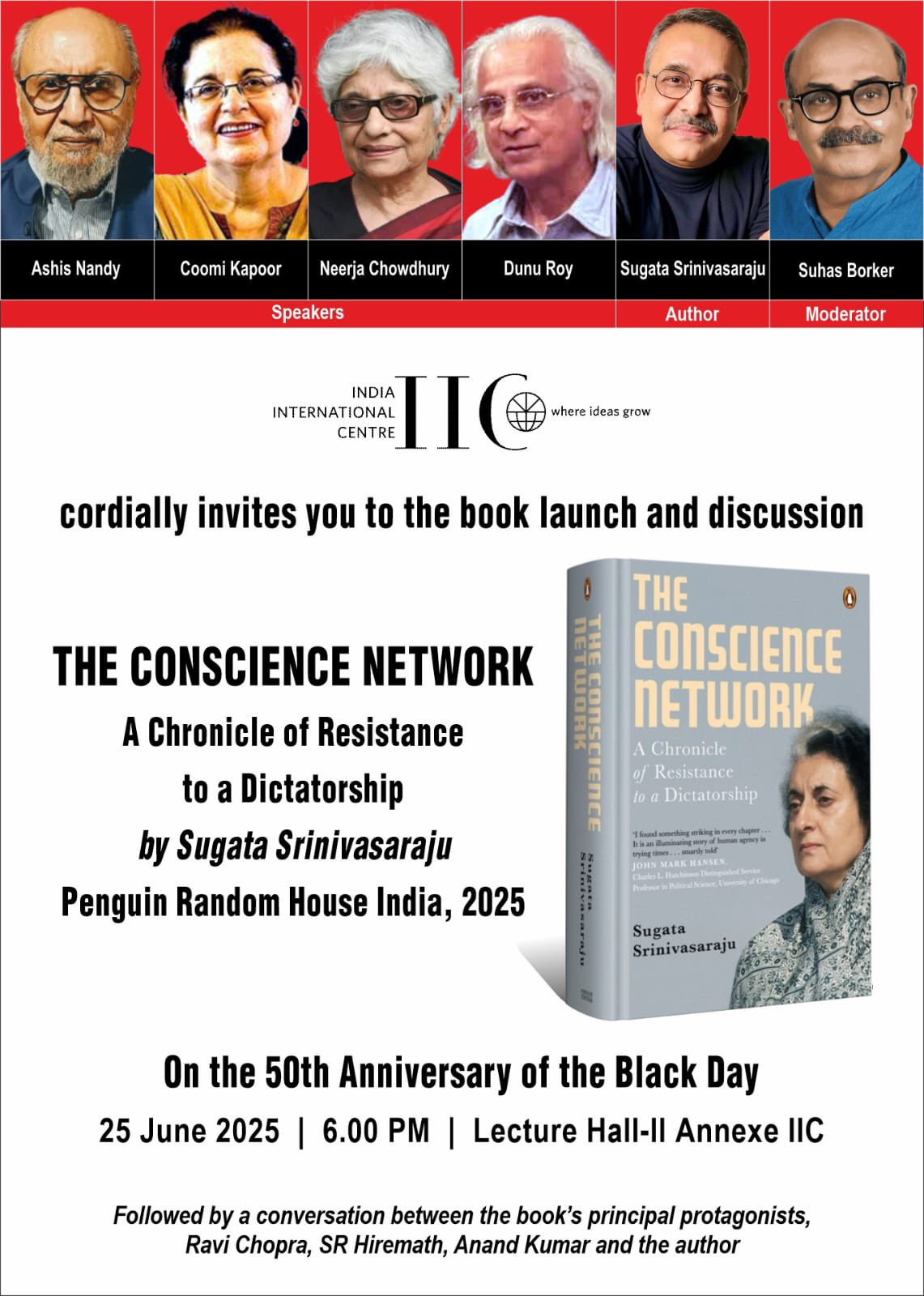
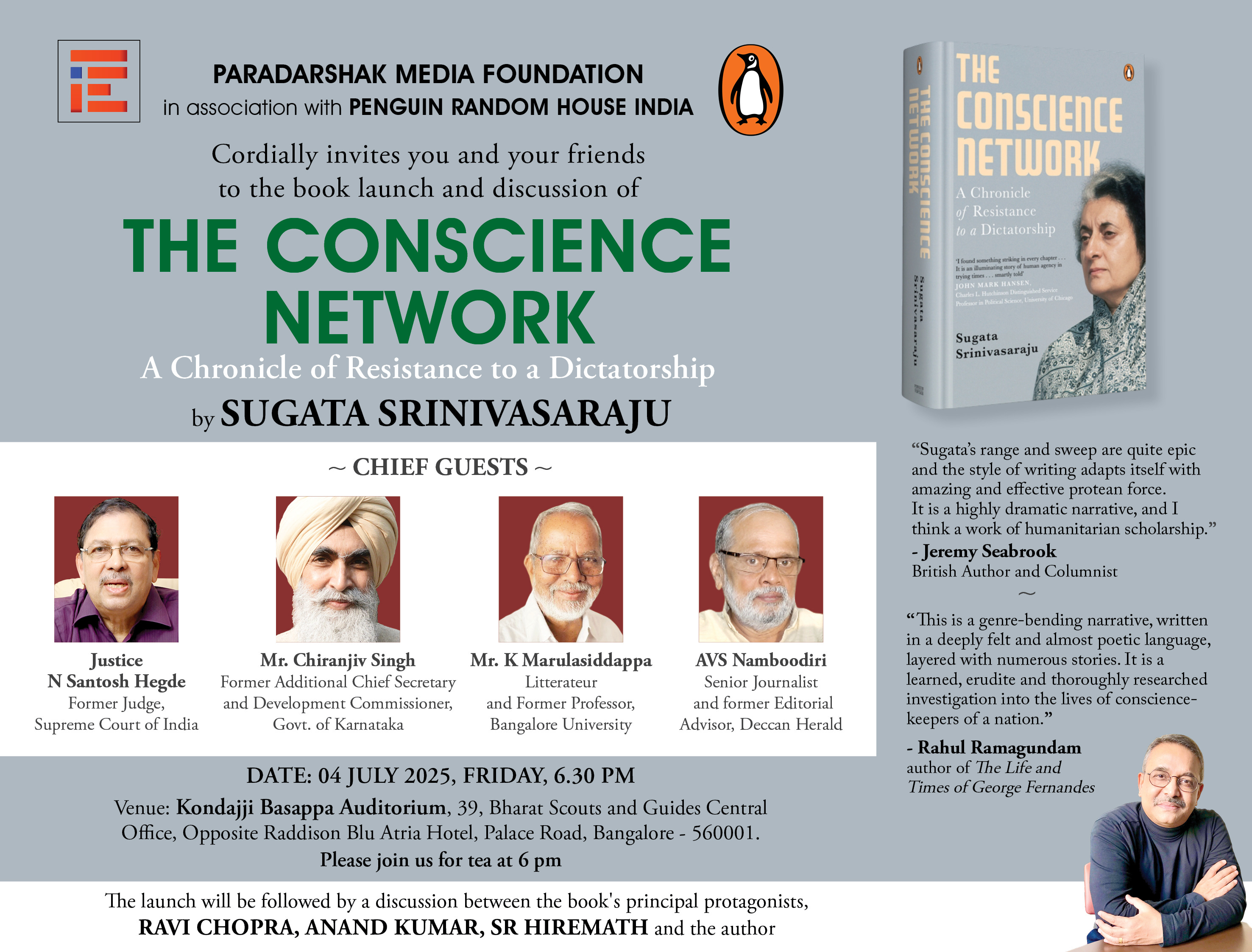
Book launch events were held in three different cities: Delhi, Bangalore and Mumbai. Here’s how the invites looked:
New Delhi:
Bangalore:
Mumbai: